Average Bicep Size for Men and Women
The average bicep size for men in the US is 13.7 inches (34.7 cm). The average bicep size for women is 13.0 inches (32.9 cm). Both figures are upper arm measurements from the latest national health survey, and they’re here as a reference, not a target.
Where these numbers come from
Every figure in this post comes from one source: the US National Health and Nutrition Examination Survey, run by the Centers for Disease Control and Prevention (CDC). Trained staff measured thousands of adults between August 2021 and August 2023, so these are real tape-measure readings, not numbers people reported themselves.
You can read the full report here: Anthropometric Reference Data for Children and Adults: United States, August 2021–August 2023 (Fryar and colleagues, National Center for Health Statistics, June 2025). The survey calls this measurement “mid-upper arm circumference”.
Average bicep size for men by age
The survey measured 2,652 men aged 20 and older.
| Age | Inches | Centimetres |
|---|---|---|
| All men, 20 and older | 13.7 | 34.7 |
| 20 to 29 | 13.5 | 34.3 |
| 30 to 39 | 13.9 | 35.4 |
| 40 to 49 | 14.2 | 36.0 |
| 50 to 59 | 13.9 | 35.2 |
| 60 to 69 | 13.4 | 34.0 |
| 70 to 79 | 13.1 | 33.4 |
| 80 and older | 12.5 | 31.7 |
Average bicep size for women by age
The survey measured 3,198 women aged 20 and older.
| Age | Inches | Centimetres |
|---|---|---|
| All women, 20 and older | 13.0 | 32.9 |
| 20 to 29 | 12.6 | 31.9 |
| 30 to 39 | 13.3 | 33.9 |
| 40 to 49 | 13.2 | 33.6 |
| 50 to 59 | 13.3 | 33.8 |
| 60 to 69 | 12.9 | 32.8 |
| 70 to 79 | 12.6 | 32.1 |
| 80 and older | 11.7 | 29.8 |
Most people aren’t the average
An average is one number pulled from a very wide range, and the range tells you more.
- Half of the men measured between 12.4 and 14.8 inches (31.5 to 37.5 cm). The middle value was 13.5 inches (34.4 cm).
- Half of the women measured between 11.3 and 14.2 inches (28.7 to 36.1 cm). The middle value was 12.6 inches (32.1 cm).
That means half of everyone measured sits outside those ranges, too. Arms come in all kinds of shapes, and your height, age and build all play a part in your number.
How the survey measures an arm
The survey’s staff find the point halfway between the shoulder and the elbow, then wrap a tape measure around the arm there. The arm is relaxed, not flexed.
So the number covers the whole upper arm, not just the bicep muscle. If you measure your arm flexed, at its widest point, your reading will usually be bigger than the ones in these tables. That’s worth knowing before you compare.
How to measure your bicep

You only need a soft tape measure.
- Let your arm hang loosely by your side.
- Find the midpoint between the top of your shoulder and your elbow.
- Wrap the tape around your arm at that point. Keep it level and snug, without pressing into the skin.
- Measure both arms. It’s normal for them to differ a little.
Some people prefer to measure flexed instead, and that’s fine. Just pick one way and stick with it, so your readings are comparing like with like. Our guide on how to take body measurements has a photo for every measurement, and when to take your measurements has more on keeping them consistent.
Your own trend matters most
Whatever your goal, the most useful comparison is with yourself. One measurement is a snapshot. A few months of them shows you which way you’re heading, and that’s what keeps you going.
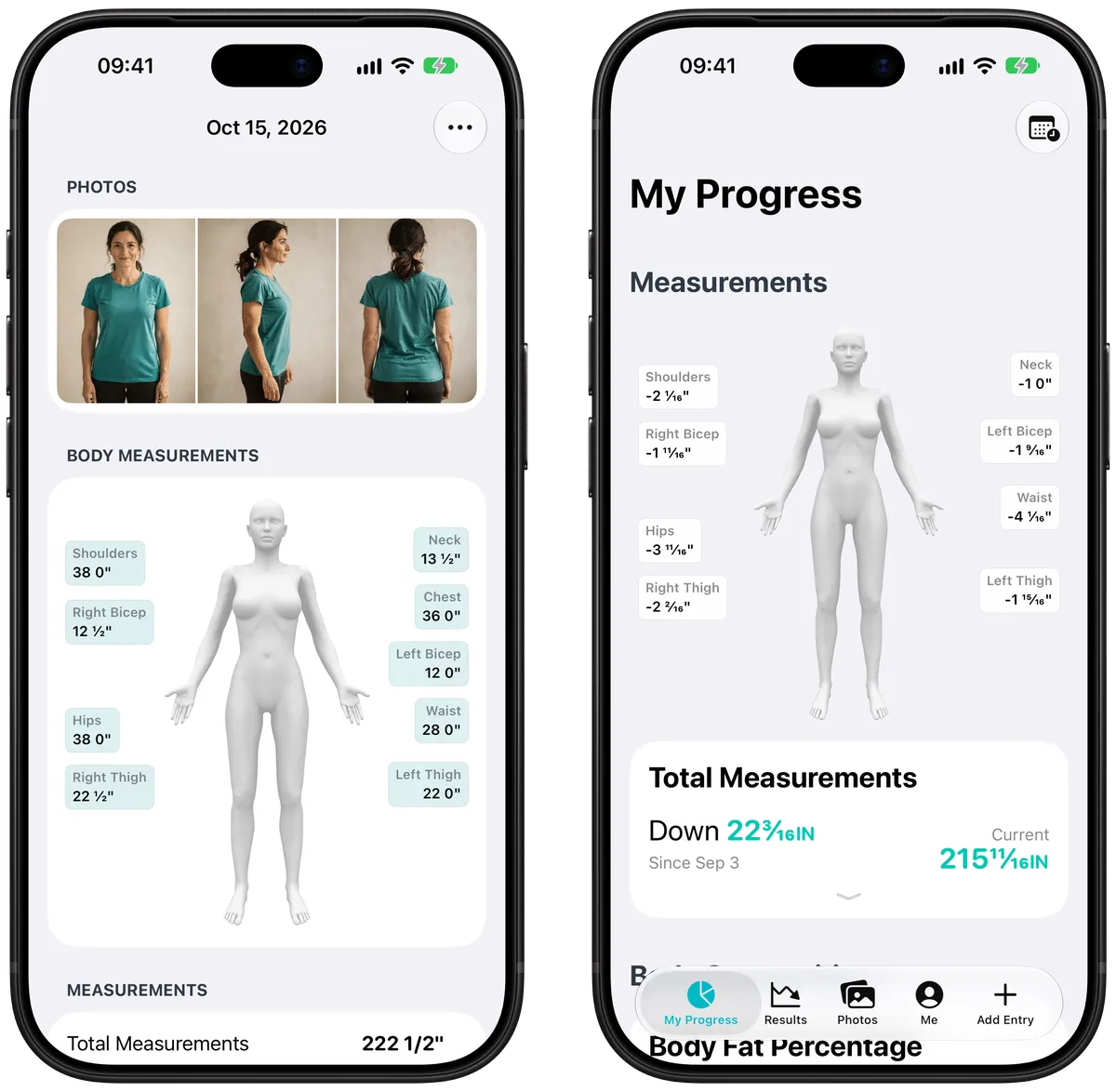
Progress tracks your left and right bicep separately, alongside your other body measurements, your weight and your photos. Download Progress from the App Store and add your first measurement today.
More averages
Curious about another measurement? See the average waist size, average hip size, average chest size, average shoulder width, average forearm size and average thigh size. You’ll find them all under average measurements.