
Average Waist Size for Men and Women
The average waist size for men in the US is 40.6 inches (103.0 cm). The average waist size for women is 38.5 inches (97.9 cm). Both figures come from the latest national health survey, and they’re here as a reference, not a target.
Where these numbers come from
Every figure in this post comes from one source: the US National Health and Nutrition Examination Survey, run by the Centers for Disease Control and Prevention (CDC). Trained staff measured thousands of adults between August 2021 and August 2023, so these are real tape-measure readings, not numbers people reported themselves.
You can read the full report here: Anthropometric Reference Data for Children and Adults: United States, August 2021–August 2023 (Fryar and colleagues, National Center for Health Statistics, June 2025).
Average waist size for men by age
The survey measured 2,605 men aged 20 and older.
| Age | Inches | Centimetres |
|---|---|---|
| All men, 20 and older | 40.6 | 103.0 |
| 20 to 29 | 37.4 | 95.1 |
| 30 to 39 | 39.9 | 101.3 |
| 40 to 49 | 41.2 | 104.7 |
| 50 to 59 | 41.9 | 106.4 |
| 60 to 69 | 41.5 | 105.4 |
| 70 to 79 | 42.3 | 107.5 |
| 80 and older | 41.0 | 104.1 |
Average waist size for women by age
The survey measured 3,121 women aged 20 and older. Pregnant women weren’t included.
| Age | Inches | Centimetres |
|---|---|---|
| All women, 20 and older | 38.5 | 97.9 |
| 20 to 29 | 35.6 | 90.5 |
| 30 to 39 | 38.5 | 97.8 |
| 40 to 49 | 38.7 | 98.2 |
| 50 to 59 | 40.0 | 101.5 |
| 60 to 69 | 39.5 | 100.3 |
| 70 to 79 | 39.2 | 99.6 |
| 80 and older | 38.0 | 96.5 |
Most people aren’t the average
An average is one number pulled from a very wide range, and the range tells you more.
- Half of the men measured between 36.0 and 44.2 inches (91.4 to 112.3 cm). The middle value was 39.7 inches (100.9 cm).
- Half of the women measured between 33.4 and 43.0 inches (84.9 to 109.2 cm). The middle value was 37.7 inches (95.7 cm).
That means half of everyone measured sits outside those ranges, too. Bodies come in all kinds of shapes, and your height, age and build all play a part in your number.
How the survey measures a waist
The survey’s staff place the tape around the body at the top of the hip bone. That’s a little lower than where many of us measure at home, which is usually halfway between the bottom of the ribs and the top of the hips. So your own number may differ slightly from the tables just because of where the tape sits.

Neither spot is wrong. What matters is that you measure the same place every time. Our guide on how to take body measurements shows where to put the tape, with a photo for every measurement. Our post on waist circumference covers the waist in more detail, and when to take your measurements explains how to keep your readings consistent.
An average isn’t a goal
It’s natural to want to see where you sit. But an average describes a whole country. It can’t tell you what’s right for your body.
If you’d like a number that’s about you, your waist compared with your height is more useful than your waist alone. Try our free waist-to-height ratio calculator to check yours. And if anything about your health is worrying you, your doctor is the best person to talk to.
Your own trend matters most
The most useful comparison is with yourself. One measurement is a snapshot. A few months of them shows you which way you’re heading, and that’s what keeps you going.
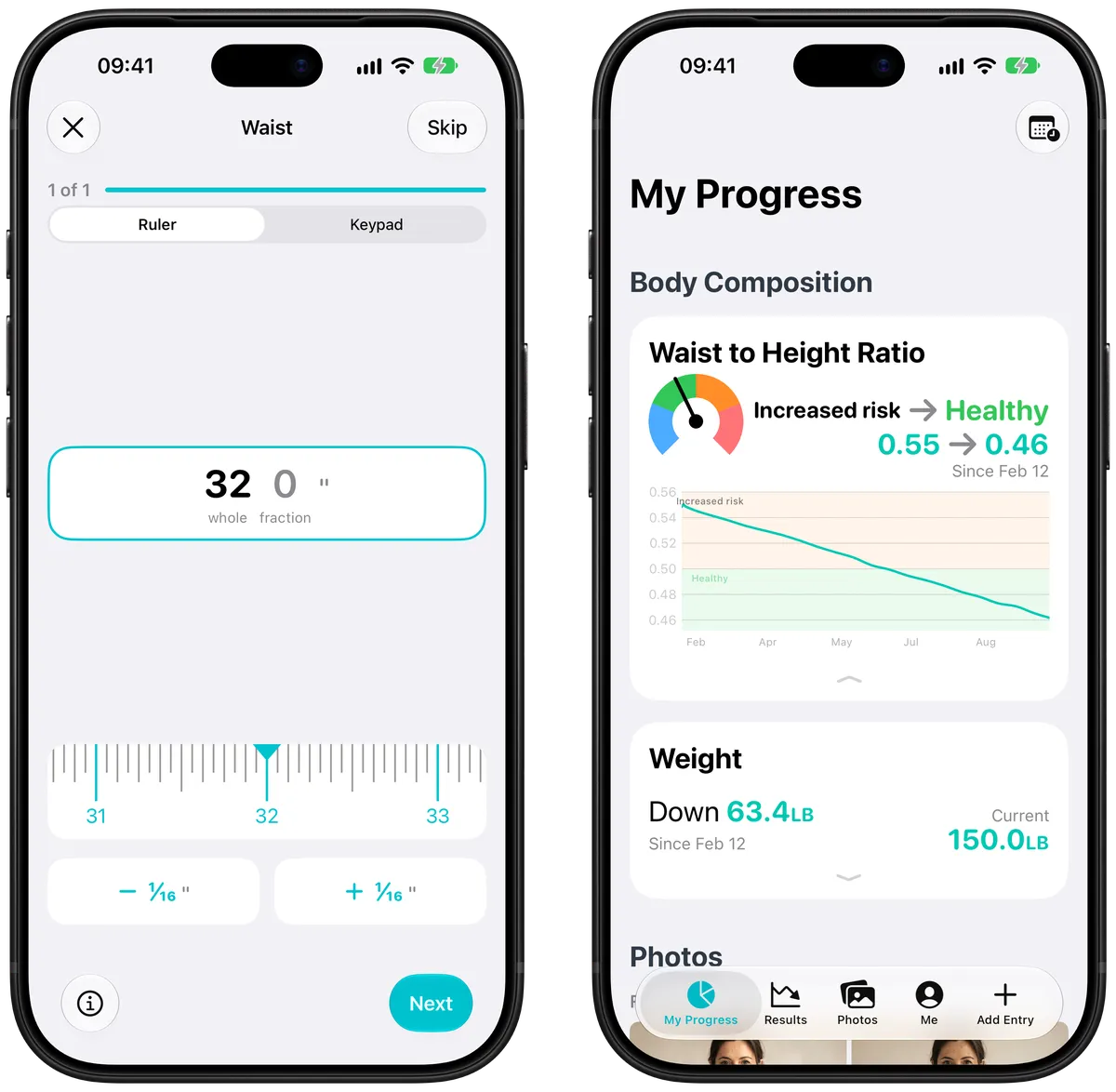
Progress keeps your waist alongside your other body measurements, your weight and your photos, so you can see every change in one place. Download Progress from the App Store and add your first measurement today.
More averages
Curious about another measurement? See the average hip size, average chest size, average shoulder width, average bicep size, average forearm size and average thigh size. You’ll find them all under average measurements. Or check your waist-to-hip ratio with our free calculator.